What’s a good 400 m swim time for your age?
The 400 m swim: 16 lengths of a 25 m pool, freestyle, without stopping. It’s a test of cardio fitness and of your stroke, since good technique saves more time in the water than anywhere else.
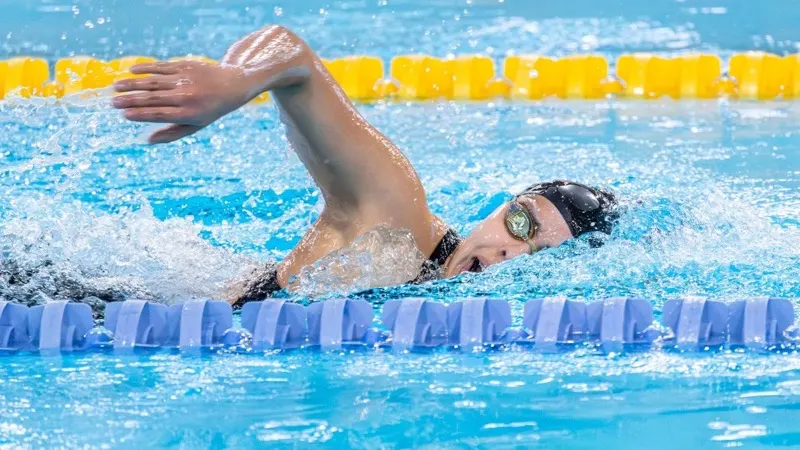
400 m swim standards by age: the short answer
For men 40–49, the average can’t swim 400 m without stopping, and the 95th percentile is 7:45. For women 40–49, the average can’t swim 400 m without stopping, and the 95th percentile is 8:40. Enter your own numbers above to see exactly where you stand.
The average and the top 5%, by age
| Age | Men | Women | ||
|---|---|---|---|---|
| Average | Top 5% | Average | Top 5% | |
| 18–29 | Can’t, non-stop | 6:38 | Can’t, non-stop | 7:11 |
| 30–39 | Can’t, non-stop | 7:12 | Can’t, non-stop | 7:55 |
| 40–49Your age | Can’t, non-stop | 7:45 | Can’t, non-stop | 8:38 |
| 50–59 | Can’t, non-stop | 8:32 | Can’t, non-stop | 9:43 |
| 60–69 | Can’t, non-stop | 9:18 | Can’t, non-stop | 10:45 |
| 70+ | Can’t, non-stop | 10:10 | Can’t, non-stop | 12:05 |
The average is the 50th percentile of people that age and sex in the general population, not just athletes; the top 5% start at the 95th.
Questions
What does the percentile mean?
It’s the share of people your sex and age you beat. At the 50th you’re average; at the 95th, you’re fitter than 95 of 100. Because it’s ranked by age, your target moves as you get older: holding the 95th at 70 takes a lower number than it did at 40.
How much does swimming fitness matter for health?
Your swim time follows your cardio fitness, one of the strongest predictors of how long, and how well, you’ll live: the fittest people have about a fifth of the risk of death of the least fit (Mandsager, 2018). Swimming is almost free of impact, so it’s fitness you can keep building into your 80s.
Why is the average “can’t, non-stop”?
Most adults can’t swim 400 m without stopping, so the average adult has no time to rank. If you can swim it non-stop at any pace, you’re already in the top half or so of people your age.
Where do the numbers come from?
No survey times ordinary adults over 400 m, so the top 5% is our estimate: the slowest 5% of USA Swimming’s 17–18-year-old club swimmers for people in their 20s, slowed with age as Cooper’s 12-minute swim ratings slow. See our methods page for the details.
How do I swim faster?
Swim two to four times a week. Technique matters more than in any other sport, so a lesson or a video of your stroke often helps more than extra laps. Add sets of hard 50s or 100s with short rests.
Population-level data exists for some health and fitness measures, such as VO₂ max, but not for many others. For those, we estimate the numbers from the best published data we have access to. See where our numbers come from for full details.
Updated November 2026 · By Yevgeniy Brikman · Methods and sources · Not medical advice