How much should you be able to squat?
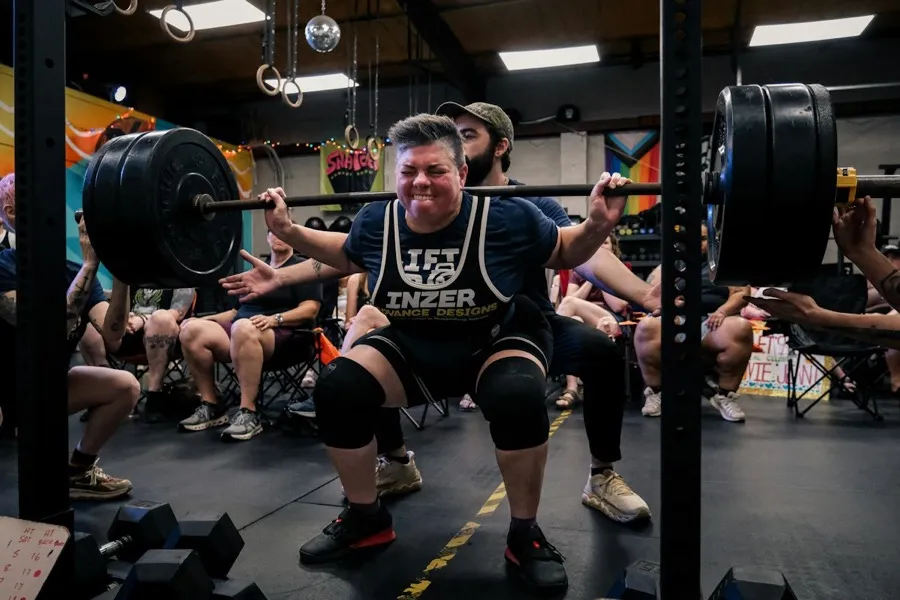
The back squat: a barbell across your upper back, sit down from knees and hips fully locked out until the crease of your hips is below your knees, then stand back up until they lock out again. It trains the legs and hips you use to climb stairs, get out of a chair, and get up off the floor, the muscles that weaken fastest with age.
Squat standards by age: the short answer
For men 40–49 weighing 195 lb, the average is 85 lb, and the 95th percentile is 260 lb. For women 40–49 weighing 165 lb, the average is 50 lb, and the 95th percentile is 145 lb. Enter your own numbers above to see exactly where you stand.
The average and the top 5%, by age
| Age | Men | Women | ||
|---|---|---|---|---|
| Average | Top 5% | Average | Top 5% | |
| 18–29 | 110 lb0.56× body weight | 320 lb1.64× body weight | 65 lb0.39× body weight | 190 lb1.16× body weight |
| 30–39 | 100 lb0.50× body weight | 290 lb1.49× body weight | 55 lb0.34× body weight | 170 lb1.02× body weight |
| 40–49Your age | 85 lb0.44× body weight | 260 lb1.33× body weight | 50 lb0.29× body weight | 145 lb0.89× body weight |
| 50–59 | 70 lb0.37× body weight | 220 lb1.13× body weight | 40 lb0.24× body weight | 120 lb0.74× body weight |
| 60–69 | 60 lb0.30× body weight | 180 lb0.93× body weight | 30 lb0.19× body weight | 95 lb0.59× body weight |
| 70+ | 50 lb0.25× body weight | 150 lb0.78× body weight | 25 lb0.15× body weight | 80 lb0.48× body weight |
The average is the 50th percentile of people that age and sex in the general population, not just athletes; the top 5% start at the 95th. Lifts are for one rep, at a typical body weight (195 lb for men and 165 lb for women); multiply your own weight by the figure under each to get yours.
Questions
What does the percentile mean?
It’s the share of people your sex and age you beat. At the 50th you’re average; at the 95th, you’re fitter than 95 of 100. Because it’s ranked by age, your target moves as you get older: holding the 95th at 70 takes a lower number than it did at 40.
How much does squat strength matter for health?
Leg strength is what keeps you independent: getting out of a chair, climbing stairs, and catching yourself when you trip. It’s also the strength that fades fastest with age. In the sitting-rising test (Brito, 2012), each point people lost getting down to the floor and back up without help went with about 21% higher risk of death over the next six years.
What if I don’t know my one-rep max?
Choose “Estimate from reps” and enter the most you lifted for up to 10 reps. Testing a true one-rep max isn’t needed, and isn’t worth the injury risk for most people.
Does a front squat or leg press count?
Not directly. A front squat is usually about 80% of a back squat, and a leg press much more than one, so they need their own standards.
How do I improve my squat?
Squat two or three times a week, in sets of 3–8 reps, adding a little weight each week while your form holds. Most people who keep at it get stronger for years.
Population-level data exists for some health and fitness measures, such as VO₂ max, but not for many others. For those, we estimate the numbers from the best published data we have access to. See where our numbers come from for full details.
Updated November 2026 · By Yevgeniy Brikman · Methods and sources · Not medical advice